Ice at the eaves and water inside after a thaw
Ice Dam Roof Repair in Montclair, NJ
Why is there a ridge of ice at the eave and a wet wall inside? Ice dams in Montclair, NJ form when heat leaks into the attic, melts the snow above it and lets the water refreeze at the edge. Your move: call (973) 358-8198 and say where the ice and the stain line up.
Stop and get safe if
- Icicles or a loose ice sheet over a door, walkway or car: keep people out from under it.
- Anyone swinging a hammer, shovel or ice pick at the eave: keep off the roof and the ladder. Chipping hurts people and shingles.
- Water coming through a ceiling light or outlet: get everyone out of that room, touch nothing and call 911 from somewhere dry.
- A snow-covered roof or an icy ladder: do not go up. Call 911 only if someone has fallen.
A January thaw, step by step
- A snowfall settles on the roof. Heat from the house, climbing through hatches, light fixtures and the tops of walls, warms the boards under the snow.
- Meltwater runs down the roof under the snow until it reaches the overhang, which is cold. There it refreezes into a ridge of ice.
- The ridge grows, and meltwater backs up behind it and finds seams in the shingles. Newark's January normals are a 32.8 mean and 9.1 inches of snow, which keeps this cycle in reach.
- When water shows inside, call (973) 358-8198.
Where the trouble starts
- Warm indoor air leaking into the attic through hatches, fans, chimneys and light fixtures
- Thin or uneven insulation, especially over the tops of the exterior walls
- An attic that does not vent from the eaves up to the ridge
- Deep snow that insulates the roof and keeps the melting going
- A cold eave that overhangs the wall and refreezes the meltwater
Short answers
- How urgent is an ice dam, by your number out of ten?
At 8 to 10 there is water at a fixture, a bulging ceiling or ice hanging over a doorway; get clear and phone 911 if it falls. At 4 to 7 water is getting into a wall or ceiling, so call (973) 358-8198 within the week. At 1 to 3, ice sits at the eave and nothing shows inside: photograph it and ask about the attic in spring.
- What makes an ice dam form?
UMass lists three ingredients: snow on the roof, warmth leaking up from the house, and cold at the overhang. The warmth melts snow high on the slope, and the meltwater freezes again at the edge. Air sealing the attic floor is the first step, per the federal Building America guide.
- Does heat tape or chipping help?
UMass researchers say heat tape adds energy to a heat-loss problem, can make shingles brittle, is a fire risk and can build a second dam above the cable. They also warn that hammers, shovels and ice picks can hurt both the person and the roof.
- Does New Jersey require an ice barrier here?
Bulletin 07-3 from the state sets the rule: an ice barrier membrane goes in where the January average is 25 degrees or lower, and the bulletin lists Sussex County. Newark, by contrast, has a January mean of 32.8. A membrane can still help at the eaves, but it does not cure the cause.
- Does an ice dam call cover Glen Ridge and Clifton?
Yes. Glen Ridge roofing and Clifton roofing are on the same line, and so are five more towns. Next step: call (973) 358-8198.
Ice at the eave, from the ground
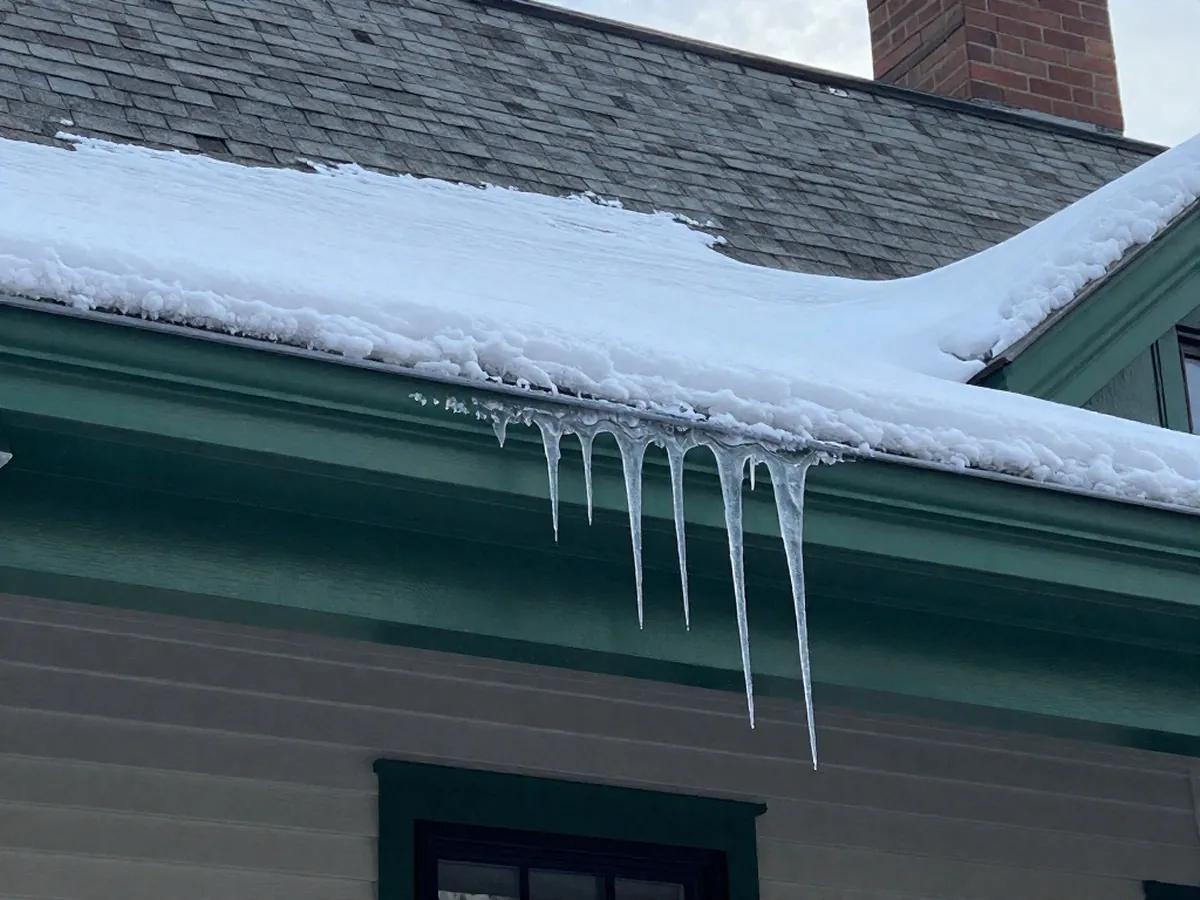
The picture shows a snowy eave with a thick band of ice, long icicles hanging past the gutter and a window frame wet below. The band is the dam. The icicles are not the problem on their own, but they show where meltwater is escaping.
The snowy eave is a rendered scene, not a photo of a real house.
On a visit
- Call (973) 358-8198 with where the ice sits, which room is wet and what the weather did the days before; the contractor can then book a look.
- The eave edge and the first few feet of roof, with damage to shingles and gutters.
- The attic: insulation depth, gaps over the wall tops and air coming up through the hatch, fans and chimney.
- Ventilation: whether air enters at the eaves and leaves at the ridge.
- The underlayment or membrane question, since a self-adhering layer is a backup and not a cure.
- A plain account of what can wait for spring, and a question about paperwork.
What to do now, and what waits until spring
- Now: keep people out from under the ice, and cover or contain any water that has come inside.
- Now: skip the hammer and the heat tape.
- After the thaw: photograph the staining and the eave damage.
- In spring: ask a roofer or an insulation contractor to look at air leaks, insulation depth and venting.
- The repair that lasts is the one that cuts heat loss; a membrane alone does not.
The ice barrier rule and Essex County
Bulletin 07-3 from the state wants an ice barrier membrane where the January average is 25 degrees or colder, and Sussex County is the county it names. Essex and Passaic do not appear in it, though a roofer may still add a membrane at the eaves.
For the rest of the paperwork, see the rules page.
More roof jobs
Sources UMass Amherst Building and Construction Technology, Preventing ice dams (2011) Building America Solution Center (U.S. DOE), Construct roofs and attics for ice dam prevention (6 Dec 2022) NJ Division of Codes and Standards, Bulletin 07-3, Ice Dam Membrane/Ice Barrier (revised Jun 2015) National Weather Service, Newark January almanac, 1991-2020 normals National Weather Service, Newark February almanac, 1991-2020 normals NIOSH, Falls from ladders are preventable (reviewed 1 Mar 2024)
Describe the roof, then dial.
Before you call (973) 358-8198, find the street address, note which room shows water and jot down roughly how old the roof is. Tenants: the owner arranges roof work, so the landlord hears about it first. Towns: Montclair, Glen Ridge, Bloomfield, West Orange, Cedar Grove, Clifton, Little Falls.